Opposite Words in English: Building Strong Vocabulary Skills
One of the commonly spoken languages around the globe is English. Therefore, becoming proficient in it would be a wise decision to make. Learning opposite words is one of the easiest and most effective methods to make English vocabulary strong. Also known as antonyms, opposite words are crucial to a child’s language development. With their help, children can express their thoughts and communicate successfully in this language. Teaching children these words is one of the fun and easiest ways to improve early education. In preschool education, the fundamental word pairs are crucial. Learning opposite words in English aids in the development of children’s linguistic and cognitive abilities. More details will be given on the significance of opposite words in English for children in this blog.

What Do Opposite Words Mean?
Words that have different meanings are called opposite words. They help kids understand how two items vary by comparing them. One of the first stages in building a strong vocabulary in children’s English is learning opposing words.
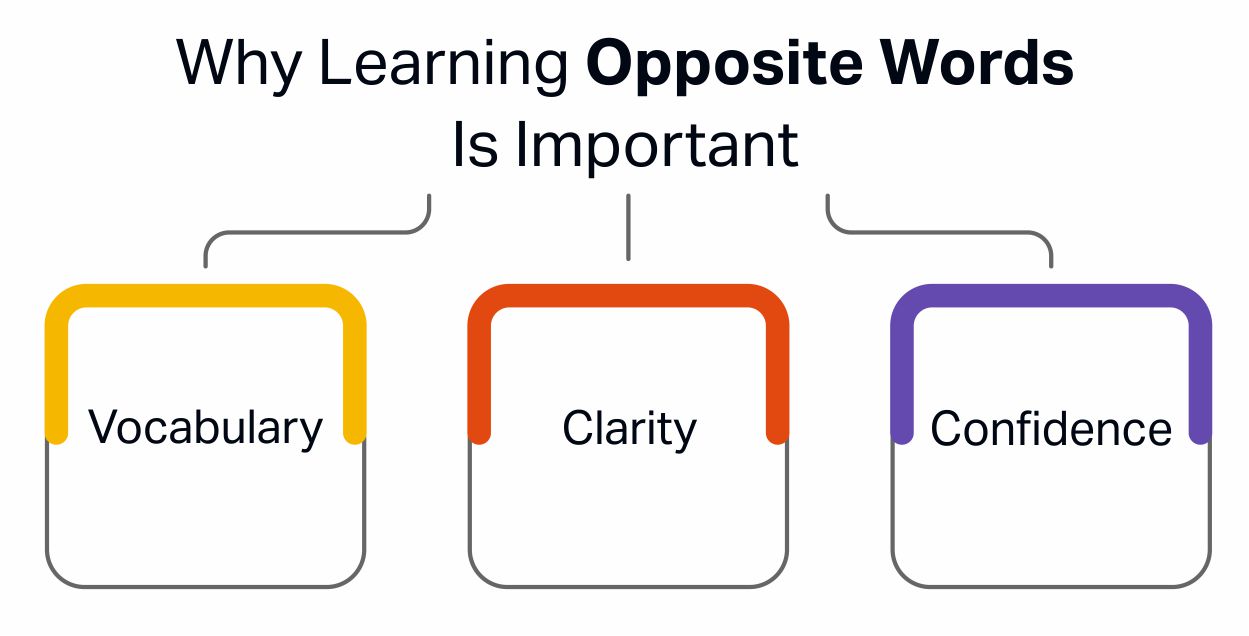
Why Opposite Words in English Are Important for Children?
Antonyms are more than just words. They help kids think more clearly and offer them an understanding of how things work. Children who learn about opposites are better able to notice, contrast, and articulate emotions or behaviours.
What are the Advantages of Learning Opposite Words in English?
Children’s ability to learn opposite words is beneficial for more than just language development. Some of the primary advantages are as follows:
Cognitive Growth
Children think more when they are able to recognise opposites. It improves comparison and problem-solving abilities. Choosing an empty or full cup, for example, improves thinking.
Understanding Concepts
The majority of concepts in life are based on opposites. Learning the opposing term can help kids follow guidelines and directives more successfully.
Development of Vocabulary
Children learn two new words for each opposing set. That’s twice as much education! Over time, kids become more confident while speaking, reading, and writing.
Example of Basic Opposite Words in English for Children to Learn
This is a list of 50 opposite words in English for kids. These are perfect for teaching at home or in a classroom.
- Above – Below
- Absent – Present
- Accept – Refuse
- Active – Lazy
- Add – Subtract
- Admit – Deny
- Adult – Child
- Agree – Disagree
- Alive – Dead
- Always – Never
- Ancient – Modern
- Answer – Question
- Appear – Disappear/Vanish
- Approve – Disapprove
- Arrive – Depart
- Ask – Reply
- Awake – Asleep
- Bad – Good
- Beautiful – Ugly
- Begin – End
- Big – Small
- Bold – Timid
- Bright – Dark
- Buy – Sell
- Calm – Angry
- Careful – Careless
- Cheap – Expensive
- Clean – Dirty
- Cold – Hot
- Come – Go
- Dark – Light
- Day – Night
- Deep – Shallow
- Easy – Difficult
- Empty – Full
- Enemy – Friend
- Fast – Slow
- First – Last
- Give – Take
- Hard – Soft
- Heavy – Light
- High – Low
- In – Out
- Inside – Outside
- Laugh – Cry
- Left – Right
- More – Less
- Open – Close
- Push – Pull
- True – False
The Best Methods for Teaching Children Opposite Words
Kids learn best when it’s enjoyable. These methods are easy, enjoyable, and effective for students.
Flashcards
Use pictures of opposing words to help kindergarten kids make the connection between the word and its meaning. They learn more rapidly when there is a cheerful face next to a sad one.
Dance & Songs
Listen to music that uses opposites in pairs. Encourage kids to dance to phrases like “fast” and “slow” or “open” and “shut”. It adds excitement and enjoyment to studying.
Outdoor Education
Examples of real-world opposites include “up/down” on a slide, “day/night” by looking at the sky, and “hot/cold” via touch. For kids, it brings opposing words to life.
Role of CBSE Schools in Lucknow in Language Development
Top schools in Lucknow, including K.R. Mangalam World School (KRMWS), play an important role in language development. It does that through a structured English curriculum that builds a strong foundation of the language among students. These top schools in Lucknow focus on vocabulary building from an early stage. Besides, they use activity-based learning methods to improve speaking, reading, and writing in English effectively. These methods include storytelling, reading sessions, and classroom interactions.
KRMWS: Strengthening English Foundations
Do you know why KRMWS is regarded as the best school in Lucknow? Well, for the very reason that it strengthens foundational knowledge of English through daily vocabulary practice and engaging language-related activities. By encouraging active participation and regular use of new words, the school helps students communicate confidently and develop strong English skills from an early age.
Conclusion
To sum up, learning opposite words in English could be a fun, engaging and knowledge-building activity for kids. Kids can easily learn these terms through simple activities, songs, and everyday scenarios without feeling worried.
Schools in Lucknow play a key role in supporting language development through structured learning and engaging activities. Choosing schools like KRMWS ensures a strong English foundation that supports academic success and effective communication skills.
Want to build a strong English foundation for the children?
Choose KRMWS, where daily vocabulary practice and engaging language activities help students develop confident communication skills from the start.
FAQs
Q1. What are opposite words in English?
Opposite words, also called antonyms, are words that have contrasting meanings, such as hot–cold or big–small.
Q2. Why should students learn opposite words in English?
Learning opposite words helps improve vocabulary, understanding, and correct word usage in sentences.
Q3. How can children easily remember opposite words?
Through regular practice, visual learning, games, and using the words in daily conversations.
Q4. How does KRMWS help students improve their English foundations?
KRMWS encourages daily vocabulary practice, engaging language activities, and confident communication.


Comments
Post a Comment