Importance of Play-Based Learning Activities for Children
Playing is much more than just a fun activity for children; it is a vital way through which they develop both physically and mentally. In today’s evolving education system, play based learning activities have become essential for nurturing young minds. For young children, these activities help in the development of cognitive, social, and motor abilities. With these activities, kids can connect and explore in natural, age-appropriate ways. In addition to improving their educational experience, they establish the groundwork for lifelong learning. This blog examines the various aspects of play based learning activities and their crucial role in children’s development.

What is Play-Based Learning?
It is a child-centred approach where children learn through activities such as games, storytelling, role-play, and other hands-on experiences. This method encourages curiosity, imagination, and active participation.
Types of Play-Based Learning Activities
Here are different types of play based learning activities:
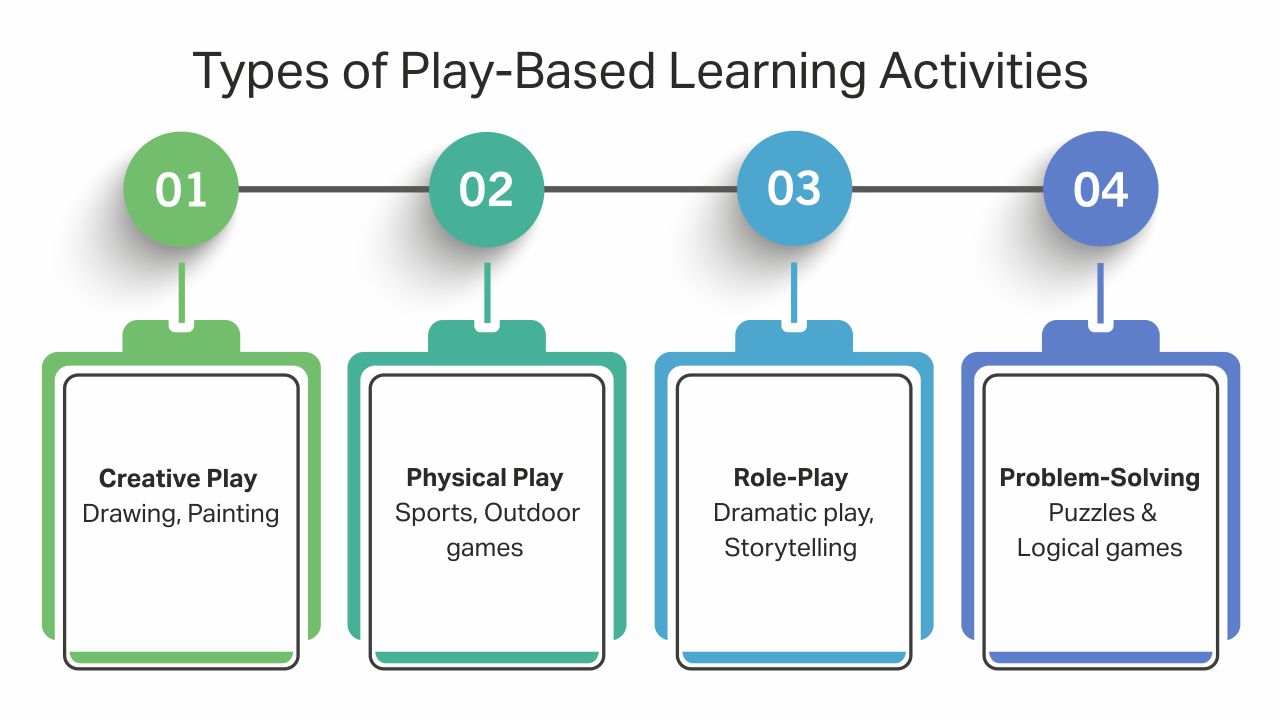
- Creative Play: Activities like drawing, painting, and other crafts help children express themselves.
- Physical Play: Outdoor games and sports improve motor skills and physical fitness.
- Role-Play & Dramatic Play: Role-play activities enhance imagination and social interaction.
- Puzzle & Problem-Solving Activities: These activities boost logical thinking and decision-making skills.
Importance of Play-Based Learning Activities
Here are the reasons that showcase why these activities are important:
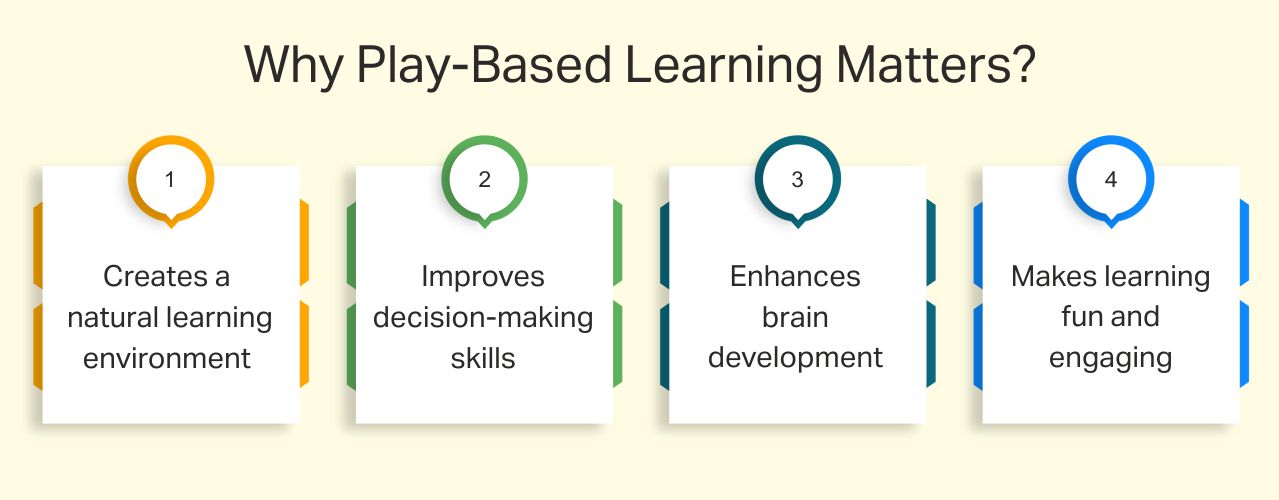
Natural and Engaging Learning Environment
Children feel at ease and motivated to explore in a natural and engaging learning environment created by play based learning activities. In contrast to traditional teaching techniques, the play-based approach gives students the chance to explore their environment, which fosters a passion for learning.
Children learn via play as they attempt to understand various solutions and their consequences, which enables them to make appropriate decisions in their lives. The child’s brain develops in a more effective manner as a result of this practical experience, which also helps them understand their physical surroundings.
For instance, children learn about forms, sizes, and spatial relationships—basic mathematical concepts—when they play with building blocks. In a similar vein, role-playing exercises like managing a fictitious grocery shop foster the growth of social skills and a comprehension of business. Compared to typical classroom training, these interactive experiences make learning more fun, simpler for kids to understand, and more memorable.
Physical Growth
Play based learning activities foster physical growth. Running, jumping, and climbing are examples of activities that promote children’s physical activity and improve their gross motor abilities. On the other side, fine motor skills are developed through activities like cutting, drawing, and handling small objects. Promoting these physical activities is crucial for enhancing body coordination and supporting overall growth.
Also, regular playtime exercise is essential for controlling weight, preserving bone health, building muscle, and promoting cardiovascular health. It also helps avoid several ailments. In addition to having fun, youngsters who participate in playful interactions develop a lifelong habit of exercising.
A Positive Outlook on Education
A child’s early years are critical in laying the groundwork for their future academic achievement. A child’s attitude toward school and learning may be greatly influenced by positive learning experiences throughout these early years.
Youngsters who have encouraging early learning experiences are more likely to have a favourable attitude toward school, are ready to work hard, deal with obstacles, and have a lifetime knack for learning.
Fostering a positive attitude towards learning is one of the most important advantages of play-based learning. A child’s motivation is greatly influenced by their interests; when they are involved in things they like, they are more ready to learn. As play-based learning combines activities that children find exciting and interesting, it makes education pleasant and engaging and encourages children to participate actively.
Enhanced Creativity and Imagination
Playing exercises foster imagination and creativity to generate completely original, unconventional, innovative ideas while studying. Children are able to create their own stories, scenarios, and solutions in this manner. Problem-solving abilities and cognitive growth depend on this creative process.
For example, building an imagined fort out of blankets and pillows not only demonstrates a child’s inventiveness but also requires spatial reasoning and decision-making. These kinds of games encourage children to utilise their imaginations and come up with original solutions to the challenges they encounter while playing.
Due to these reasons, parents searching for top schools in Lucknow need to ensure that the schools in their list promote play-based learning activities.
Why Select K.R. Mangalam World School, Lucknow?
K.R. Mangalam World School, Lucknow, is one of the top CBSE schools in Lucknow. It embraces the concept of play based learning activities as a core part of its early education approach. The school creates a stimulating and child-friendly environment where learning goes beyond textbooks and becomes an engaging, hands-on experience.
This top school in Sharda Nagar Lucknow, ensures that children actively participate in the learning process. It does this by integrating activities such as storytelling, role play, creative arts, and interactive games into daily lessons.
Conclusion
To sum up, understanding what is play based learning helps parents make better educational choices for their children. Schools that adopt play based learning activities create a strong foundation for lifelong learning.
K.R. Mangalam World School, Lucknow, ranked as one of the top schools in Lucknow, is known for integrating play based learning activities into its early education curriculum.
To ensure the holistic development of your children, enrol them in KRMWS, Lucknow, today!
FAQs
Q1. What is play based learning?
Play-based learning is an approach where children learn through play, exploration, and hands-on activities.
Q2. Why are play based learning activities important?
They help in developing cognitive, social, emotional, and creative skills in children.
Q3. Which are the top schools in Lucknow for early education?
K.R. Mangalam World School, Lucknow, is considered among the top choices for its modern and activity-based learning approach.
Q4. Is play-based learning suitable for primary education?
Yes, it builds a strong foundation and makes learning more engaging and effective.


Comments
Post a Comment